
Motocross goggles operate in conditions that ordinary sports glasses can withstand for minutes: mud thrown at speeds of 60-90 km/h, rocks with an energy of dozens of joules, and rapid changes in temperature and humidity. Choosing goggles is about choosing protective gear, not just a helmet accessory. In this guide, we break down the factors: fit, lens system, compatibility with accessories, materials, and price. We list specific models and provide parameters worth considering.
1. Helmet fit, the first parameter, not the price
Every pair of goggles has a unique frame shape, whether wide (e.g., Oakley Airbrake, 100% Armega) or classic (Scott Prospect, Leatt Velocity 6.5). A mismatch manifests itself in two ways:
- the gap on the forehead between the goggles and the helmet opening allows sand and dust into the eye area,
- pressure on the nose or cheekbones after 20-30 minutes of riding.
The goggle strap should go over the helmet's ears, not under. The strap buckle must be adjustable enough to allow the goggles to be removed and put on while wearing gloves, without removing the helmet.
Test before purchase (stationary store): Put on your own helmet, put on your goggles, and place your finger on each contact point: forehead, temples, cheekbones, nose. Check for a gap of no more than 2-3 mm.
Online purchase: Always check the compatibility chart on the goggle manufacturer's website (Oakley and 100% publish a list of helmets they've tested with). If you're buying for a specific helmet (e.g., AGV AX9, Shoei VFX-WR, Fox V3), enter the goggle model + helmet model into the search box before purchasing.
2. Lens system, single lens vs dual lens (anti-fog)
This is the most frequently overlooked parameter by beginners, and the number one reason for returns.
Single lens (single glass):
- lower cost (−30-40% vs dual lens),
- ALWAYS evaporates in humid air below 15°C,
- standard in cheap goggles up to PLN 200.
Dual lens (two panes with spacer):
- there is an air cushion between the panes that acts as an insulator,
- does not fog up in 95% conditions typical for driving in Poland (rain, autumn, spring),
- standard in the mid-range and high-end.
Poland's climate = damp forests, autumn training, spring mud. A single lens saves 70-100 PLN, which translates to 5-6 stops along the way to wipe the windshield. Dual lens is a minimum.
Dual lens models available in popular price ranges:
- Scott Prospect (~650 PLN), Lens Lock System, lens replacement in 10 seconds,
- 100% Armega (~750 PLN), UltraHD lens, widest field of view in its class,
- Oakley Airbrake MX (~700-900 PLN), Switchlock technology, quick glass replacement,
- Leatt Velocity 6.5 (~450 PLN), rigid frame, good alternative to Scott Prospect for less money,
- 100% Accuri 2 (~280 PLN), entry-level with dual lens, a good option for your first goggles.
3. Compatibility with accessories, check BEFORE you buy
Your choice of goggles determines what accessories you'll use for the next two to three years. Three categories of accessories impact riding comfort more than the goggle brand itself.
a) Tear-offs
Thin layers of film adhered to the windshield. During a race or training session, when the windshield becomes covered in mud, you peel off the top layer. Beneath that is another, clean layer. Standard: 10-20 layers per set.
Not all goggles accept tear-offs. Attendance is required. pins (post system) on the sides of the frame. Models that HAVE pins: Scott Prospect, 100% Armega, 100% Racecraft 2, Oakley Airbrake MX, Leatt Velocity 6.5. Models WITHOUT pins: most recreational goggles up to PLN 150.
Check it out Before purchasing goggles. If you plan to ride in the mud or in competitions, lack of tear-off compatibility = replacement goggles.
More in our guide: Skidding vs Roll-Off, what to choose and when.
b) Roll-off system
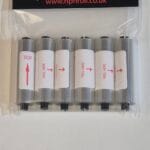
A mechanism with two rollers on the sides of the goggles pulls the clear film across the glass with the pull of a string. It works like a car windshield wiper, allowing you to cycle it for 30-50 times before the film runs out.
Advantages vs. breakaways: no need to stop to breakaway, one hand remains on the handlebar, better for long enduro/cross-country races. Disadvantages: heavier, more expensive (approx. 80-150 PLN for the system + 30-50 PLN for a spare film).
Roll-off compatible models: Scott Prospect (most popular in Poland), 100% Armega, Oakley Airbrake (Switchlock + roll-off via adapter), WVS systems.
c) Replacement lenses
Each goggle (over PLN 200) has replacement lenses in several shades:
- Clear, rain, forest, autumn, evening riding,
- Smoke / dark, summer sun, open tracks,
- Iridium / mirror, very bright conditions, glare reduction,
- Photochromic, automatic change, premium, PLN 250-400.
Having at least two panes (clear + dark) is standard in Poland. Replacing takes 10-30 seconds, detailed description in How to replace the lens in your MX goggles.
4. Glass type, categories and coatings
Apart from the color, the glass is different coatings i safety class:
- Anti-fog coating, an internal coating that reduces condensation. Lost after repeated aggressive cleaning, the anti-fog lens should ONLY be cleaned with a microfiber bag, never with a finger or cloth.
- Anti-scratch coating, external, delays scratching. Not resistant to stones.
- UV400, full UV protection, standard from ~300 PLN and up.
- ANSI Z87.1 / EN 1938, a certificate of impact resistance, crucial in cross-country.
Cheap lens = no anti-fog, no UV400. For weekend training, it might be enough. For racing, no.
5. Materials, frame and foam
Frame:
- TPU (thermoplastic polyurethane), flexible, withstands bending without cracking. Standard in mid- and high-end markets.
- ABS, stiff, cheap, breaks when dropped. Low shelf.
- Polycarbonate, compromise, common in the ~300-400 PLN class.
Foam, three layers:
- contact layer (microfiber), adheres to the skin, wicks away sweat,
- shock-absorbing layer, absorbs impacts,
- inner layer, seals the frame.
After 2-3 seasons, the foam loses its elasticity and allows sweat into the eyes. In most goggles priced over 400 PLN, the foam is replaceable. Purchased once every 2 seasons, cost 30-60 PLN.
6. Field of view, narrow vs. wide frame
Three generations of construction:
- Classic (Leatt Velocity 4.5, 100% Strata, most goggles ~150-300 PLN), thick frame, field of view limited to ~170°. Better mud seal.
- Outrigger system (Oakley Airbrake), thin frame, straps attached to extended arms. 190-195° field of view, less "tunnel" in peripheral vision.
- 1:1 mask (100% Armega, Scott Prospect Plus), extremely wide field, almost 200°. Perfect for enduro where peripheral control (branches, rocks) is critical.
For beginners, the classic design is sufficient. For intense forest/enduro riding, the 1:1 hood transforms the riding experience.
7. Price vs. Quality, What You Get in Each Price Range
Specifically, what you buy for a given amount (retail prices, 2026, Polish market):
100-200 PLN, start goggles (Fly Zone, FXR Boost for younger riders, IMX Endurance):
- single lens, basic anti-scratch,
- ABS frame, double-layer foam,
- no compatibility with tear-offs/roll-offs,
- for in-season training, NOT for racing.
250-450 PLN, mid-range, first major purchase:
- dual lens, anti-fog, UV protection,
- TPU frame, three-layer foam,
- compatibility with tear-offs and roll-offs,
- models: 100% Accuri 2, 100% Strata 2, Scott Recoil Xi, Leatt Velocity 4.5.
500-900 PLN, higher end, intense/racing rider:
- premium dual lens (UltraHD at 100%, Lexan at Scott),
- full compatibility with a wide range of accessories,
- replaceable foam, ANSI certificates,
- models: Scott Prospect, 100% Armega, Oakley Airbrake MX, Leatt Velocity 6.5.
1000+ PLN, racing and photochromic goggles:
- photochromic lens as standard,
- signed editions (GP riders),
- widest field of view, lightest construction.
Money above PLN 500 does NOT go to the brand, it goes to: the width of the field of view, the speed of replacing the lens, the quality of the anti-fog, the replaceability of the foam.
The most common beginner mistakes
- Purchase based solely on the appearance/color of the helmet, goggles that don't fit the shape of the helmet will move and let in sand regardless of price.
- Single lens "because it's cheaper"„, in Poland the driving season is 60-70% in wet conditions. Fog will stop you on the road after 5 minutes.
- No spare glass or breakaways, one quick clear for the entire season is a guaranteed accident in the sun or an abandoned workout in the mud.
- Untested helmet compatibility, goggles bought online that don't fit into the helmet opening = return or waste of money.
- Ignoring maintenance, the lens has a scratched anti-fog coating, the foam is compressed after a season, and the strap elastic is worn. Everything is replaceable, but only if you purchased the goggles with modular accessories.
What to buy with goggles (must-have)
Regardless of the goggle model, the must-have list for the first season:
- Set of breakers (10-20 pcs), matching a specific goggle model (Oakley tear-offs DO NOT fit Scott Prospect). Cost: 20-40 PLN.
- Spare clear or dark lens, the opposite shade than the one in the set. Cost: 80-180 PLN depending on the model.
- Microfiber transport bag, protects the lens in a backpack. Often included with the goggles, if not, 20-30 PLN.
- Anti-fog cleaning fluid, optionally, regenerates the coating. PLN 30-50.
- Optional: roll-off system, if you plan on mud racing/enduro. 80-150 PLN + spare videos.
→ All accessories for Scott, 100%, Oakley, Leatt and Rip N Roll, in store ProGogle.pl.
Checklist before purchasing goggles
- Do they fit my helmet? (I checked the compatibility chart)
- Do they have dual lenses?
- Do they have tear-off pins? (if I plan on racing/mud)
- Is the frame TPU, not ABS?
- Does the manufacturer offer spare lenses in different shades?
- Can I buy spare foam for ~30-60 PLN?
- Do I buy a set of tear-offs + a spare lens straight away?
Summary
Choosing MX goggles involves optimizing seven parameters, the last of which is price. The most important: helmet fit, dual lens, tear-off and roll-off compatibility, materials (TPU, three-layer foam), and lens and foam interchangeability.
From the perspective of annual maintenance costs (breakaways + lenses + foam), the difference between mid-range and high-end goggles evens out after two seasons of intensive riding. From a cost-effective perspective, it's worth investing in a model that comes with a full range of accessories.
Already have goggles? Check them out. accessories Scott, 100%, Oakley, Leatt and Rip N Roll at ProGogle.pl. Everything in one place, shipped from Poland, in stock.